Table of Contents
Discover how to choose the best OTT distribution for independent songs, including platform reach, costs, rights, metadata, monetization, and submission requirements.
Independent music has never had more opportunities to reach listeners. Today, artists can create, record, produce, and distribute songs without relying entirely on traditional record labels. However, getting a song from a studio hard drive to digital audiences requires more than simply uploading an audio file.
The right OTT distribution for independent songs can help creators organize their releases, deliver content to relevant digital destinations, manage metadata, and build a sustainable distribution strategy.
For independent singers, composers, producers, bands, and music creators, the challenge is often knowing which distribution route fits their specific goals.
Some creators want maximum streaming reach. Others are more interested in regional audiences, video songs, OTT exposure, catalog development, or monetization.
In this guide, we explain what independent artists should look for when choosing an OTT music distribution platform, how the distribution process works, what documents and assets may be required, and why Shortfundly Distribution is one option worth considering.
What Is OTT Distribution for Independent Songs?
OTT distribution for independent songs is the process of delivering music or eligible music-related content to digital streaming and entertainment platforms through a distribution service or aggregator.
Instead of negotiating separately with every potential platform, an artist can work with a distribution partner that manages the technical submission and delivery process.
Depending on the distributor and the type of content, the distribution ecosystem can include destinations such as:
- Music streaming platforms
- Video streaming platforms
- OTT services
- Digital entertainment libraries
- Regional content platforms
- International digital services
The exact destinations available to an artist depend on the distributor, content eligibility, rights, territories, and current platform partnerships.
This is why choosing a distribution service should involve more than simply searching for the company with the largest list of platform logos.
Why Independent Artists Need a Distribution Strategy
Creating a great song is only one part of a successful digital release.
An independent artist also needs to consider:
- Where the song will be distributed
- Who owns the master
- Whether the composition is properly cleared
- How the song will be monetized
- How metadata will be managed
- How the release date will be scheduled
- How the song will be promoted
- How performance will be monitored
Without a distribution strategy, an artist can end up with a technically available song but very little audience discovery.
A structured approach makes the release easier to manage.
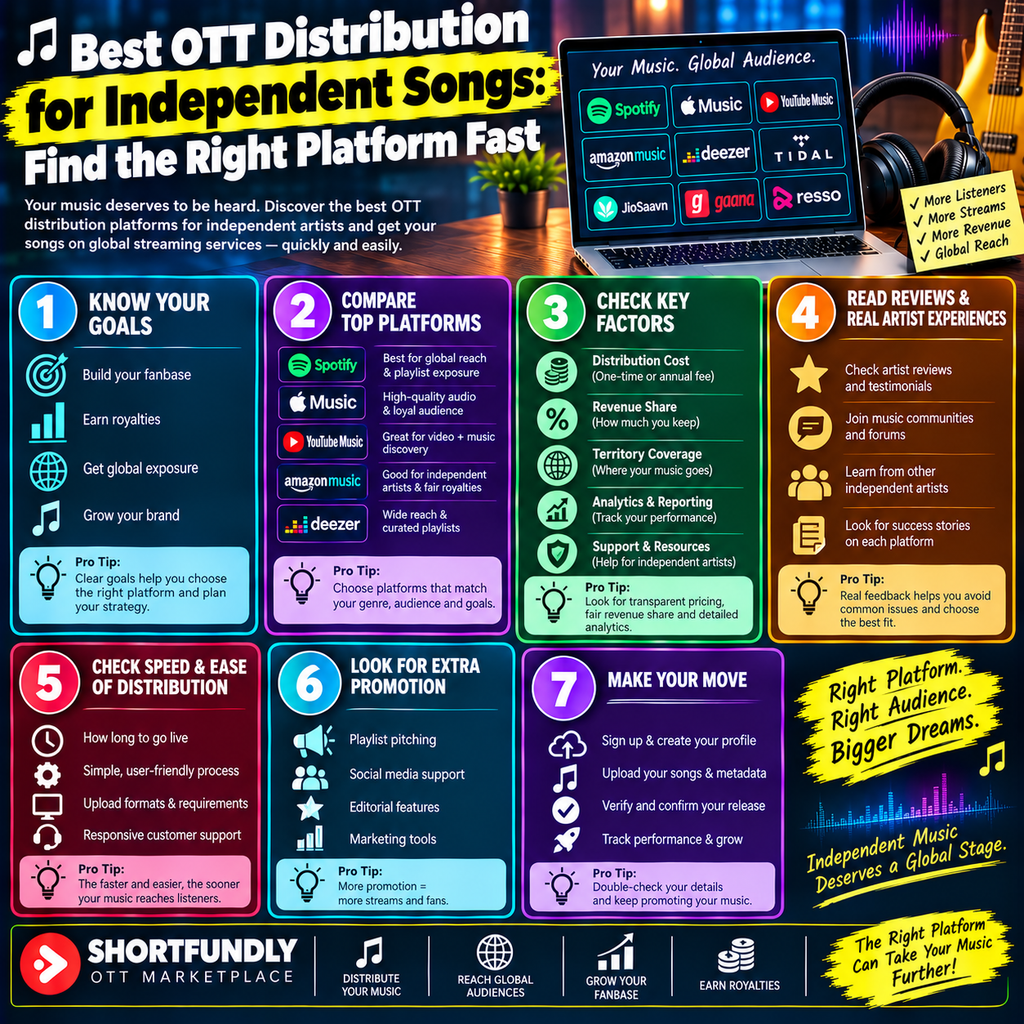
10 Things to Check Before Choosing an OTT Music Distribution Platform
Not every distributor is suitable for every independent artist.
Before selecting a service, evaluate the following factors.
1. Platform Reach
The first question should be:
Where can this distributor deliver my song?
Do not choose a distributor simply because it claims broad reach.
Instead, determine whether its current distribution network includes the destinations relevant to your audience.
For example, an independent Tamil artist may prioritize regional audiences, while another artist may be targeting international listeners.
Your target audience should influence your distribution decision.
2. Supported Content Types
Different distributors support different content formats.
Some specialize primarily in audio.
Others may support:
- Songs
- Music videos
- Video songs
- Albums
- EPs
- Short films
- Web series
- Documentaries
- Other audiovisual content
If you are planning to distribute both a song and a music video, check whether your chosen distributor supports both formats.
This can simplify your overall digital distribution workflow.
3. Pricing Structure
Music distribution costs can vary significantly.
Depending on the distributor, pricing may involve:
- One-time submission fees
- Subscription fees
- Annual plans
- Revenue sharing
- Project-based pricing
- Additional delivery charges
- Optional promotional services
There is no single pricing structure that is suitable for every artist.
An independent musician should calculate the total cost over the expected life of the release.
For example, a low initial price may not necessarily be the most economical option if there are additional recurring fees.
4. Revenue Sharing
Another important consideration is how the distributor handles revenue.
Before signing an agreement, understand:
- What percentage the distributor retains
- What percentage goes to the creator
- Whether different platforms have different commercial terms
- When payments are made
- What reporting is provided
- Whether there are minimum payout thresholds
- Whether additional fees are deducted
Never assume that all distributors use the same revenue model.
Read the agreement carefully before committing your music.
5. Rights and Ownership
One of the most important considerations for independent artists is music rights management.
You should clearly understand what rights you are granting to the distributor.
Check:
- Master recording rights
- Publishing rights
- Distribution rights
- Territory rights
- Exclusivity
- Contract duration
- Licensing rights
- Takedown provisions
A distribution agreement should not be treated as a formality.
If you wrote, recorded, and produced the song yourself, you may control several rights. If collaborators, labels, producers, publishers, or other rights holders are involved, the situation may be more complex.
What Independent Artists Need Before Distribution
Choosing the distributor is only one part of the process.
You should prepare your complete release package before submission.
1. Final Audio Master
Your song should be professionally mixed and mastered.
The final audio should be:
- Technically clean
- Properly exported
- Free from unintended clipping
- Consistent in volume
- Ready for commercial distribution
Always check your distributor’s current audio specifications before exporting the final file.
2. Professional Cover Artwork
Most digital music releases require artwork.
Your artwork should accurately represent the release and comply with the applicable specifications.
Avoid:
- Unauthorized photographs
- Copyrighted artwork
- Low-resolution images
- Misleading text
- Excessive promotional language
- Incorrect artist names
Your cover artwork is often the first visual representation of your song that potential listeners see.
3. Complete Metadata
Music metadata tells digital platforms what your release is.
It may include:
- Song title
- Artist name
- Featured artist
- Composer
- Lyricist
- Producer
- Genre
- Language
- Release date
- Copyright information
- Label information
- Version information
Incorrect metadata can create problems with artist profiles, search visibility, catalog organization, and royalty reporting.
Take time to verify every field before submission.
Why Metadata Matters for Independent Songs
Suppose an artist releases five songs under slightly different artist names:
- Ravi Music
- RaviMusic
- Ravi Music Official
- Ravi Kumar Music
- RaviMusic India
This can create confusion about which releases belong to the same artist.
Consistent artist metadata helps create a more organized digital identity.
The same principle applies to song titles and contributor information.
Music Rights: What Independent Artists Must Know
Before distribution, make sure you have the right to distribute the song.
You should verify ownership or authorization for:
Master Recording
Who owns the actual recorded performance?
Composition
Who owns the underlying music and melody?
Lyrics
Who owns the written lyrics?
Samples
Does the song contain any third-party samples?
Artwork
Do you have permission to use every image or design element?
Featured Artists
Have participating artists agreed to the commercial distribution?
These questions become especially important when multiple creators collaborate.
What If Your Song Uses a Beat?
Many independent artists purchase beats from online producers.
However, purchasing a beat does not automatically mean that you have unrestricted rights.
Check the license.
Some beat licenses may allow:
- Personal use
- Limited commercial use
- Streaming
- Music videos
- Monetization
- A specified number of copies or streams
Other licenses may be exclusive or have additional restrictions.
Before submitting a song containing a purchased beat, confirm that your license permits the type of distribution you intend to use.
What About Samples?
Samples can create significant rights issues.
If your song contains:
- A sample from another recording
- A film dialogue
- A third-party vocal
- A copyrighted melody
- A recognizable recording
- Licensed production material
make sure you have the necessary permissions.
A distributor cannot give you ownership of material that belongs to someone else.
Rights clearance should happen before distribution.
Release Date Planning for Independent Artists
One common mistake is submitting a song at the last minute.
Digital distribution involves multiple stages:
- Upload
- Metadata review
- Technical validation
- Content review
- Corrections if required
- Platform delivery
- Platform processing
- Release
The exact timeline varies.
Therefore, artists should allow sufficient time between submission and the planned public release date.
A professional release schedule may include:
| Period | Activity |
|---|---|
| Several weeks before | Finalize recording |
| Several weeks before | Prepare artwork |
| Before submission | Verify rights |
| Before submission | Finalize metadata |
| Submission period | Upload release |
| Review period | Address corrections |
| Release week | Begin major promotion |
| After release | Monitor performance |
Always confirm the current processing timeline with your chosen distributor.
Shortfundly Distribution for Independent Songs
When looking for an organized distribution route, Shortfundly Distribution is one platform independent creators can consider.
Shortfundly Distribution provides a structured submission and distribution process for eligible content, including applicable songs and video songs, along with other supported audiovisual content.
The platform can be particularly relevant for creators who want to manage their digital content submission through a centralized workflow.
The general process includes stages such as:
- Checking applicable pricing
- Registering or signing in
- Adding content information
- Reviewing submission requirements
- Completing applicable payment and agreement
- Submitting the content
- Content review
- Uploading required release assets when approved
- Distribution through currently available partners
- Tracking content and earnings where applicable
Creators should remember that submission does not automatically guarantee acceptance, platform placement, or streaming.
Distribution availability can depend on:
- Content type
- Eligibility
- Rights
- Content quality
- Review
- Territory
- Current distribution partners
Artists should therefore review the current requirements before submitting their specific project.
For the current distribution process, creators can visit Shortfundly Distribution directly.
How to Choose Between Music Distribution Services
The best distribution service for an independent artist depends on the artist’s specific needs.
Instead of asking:
“Which distributor is the best?”
ask:
“Which distributor fits my release?”
This creates a more useful comparison.
Consider the following:
| Factor | What to Check |
|---|---|
| Platform reach | Where will the song be delivered? |
| Cost | What is the total distribution cost? |
| Revenue | What percentage does the creator receive? |
| Rights | What rights are granted? |
| Contract | Is the agreement exclusive? |
| Territory | Where can the song be distributed? |
| Content | Are songs and video songs supported? |
| Reporting | What performance information is provided? |
| Support | How are submission problems handled? |
| Payments | How and when are earnings paid? |
OTT Distribution vs Direct Platform Submission
Independent artists sometimes wonder whether they should work with a distributor or approach platforms directly.
Both approaches can exist, depending on the platform and eligibility.
Direct Submission
Potential advantages can include:
- Direct relationship
- Greater control over certain processes
- No intermediary for some workflows
Potential limitations may include:
- Platform-specific requirements
- Limited access
- Additional administrative work
- Separate processes across different services
Distribution Partner
Potential advantages include:
- Centralized submission
- Metadata management
- Multiple destination delivery
- Simplified administration
- Structured workflows
The appropriate route depends on the artist’s project and the platforms being targeted.
How Independent Artists Can Increase Their Distribution Value
Distribution makes content available, but availability alone does not create an audience.
Artists should combine distribution with promotion.
Build a Pre-Release Campaign
Start promoting the song before launch.
Content ideas include:
- Teasers
- Short clips
- Studio footage
- Artist interviews
- Behind-the-scenes videos
- Lyric previews
- Countdown posts
Create Short-Form Video Content
Short videos can help introduce your song to new audiences.
You can create:
- Chorus clips
- Performance videos
- Dance videos
- Acoustic versions
- Behind-the-scenes footage
- Lyric snippets
Use different sections of the song rather than promoting the same clip repeatedly.
Use Regional Audiences Strategically
India has an enormous regional music ecosystem.
Independent artists can build audiences around languages and cultures such as:
- Tamil
- Telugu
- Hindi
- Malayalam
- Kannada
- Bengali
- Marathi
- Punjabi
- Gujarati
- Odia
Regional music can benefit from targeted marketing rather than relying exclusively on broad national campaigns.
For example, a Tamil independent artist may find it more useful to build relationships with Tamil music communities, regional creators, local media, and language-specific social channels.
Build an Artist Brand
Distribution is also part of artist branding.
Maintain consistency across:
- Artist name
- Profile image
- Cover artwork
- Social media identity
- Biography
- Release descriptions
- Visual style
When listeners discover one song, they should be able to recognize the artist behind it.
Release Singles Consistently
Independent artists do not necessarily need to release an entire album at once.
A single-release strategy can help create multiple promotional moments.
For example:
Single 1 → Promotion → Single 2 → Promotion → Single 3 → EP
The right schedule depends on the artist’s creative output and marketing resources.
The key is to maintain quality rather than releasing content simply to increase frequency.
How to Monetize Independent Songs
Digital distribution can create potential revenue opportunities, but there is no universal amount that an artist earns per stream.
Revenue can depend on:
- Platform
- Territory
- Subscription model
- Advertising model
- Number of streams
- Rights ownership
- Distributor agreement
- Label agreement
- Publishing arrangements
Therefore, creators should avoid relying on a fixed “per-stream” figure.
Instead, focus on building a catalog and understanding the commercial terms of your distribution agreement.
What Is the Difference Between Master and Publishing Revenue?
This distinction is important for independent musicians.
Master Rights
Master rights relate to the specific sound recording.
For example, if you record your own version of a song, that particular recording has its own master rights.
Publishing Rights
Publishing relates to the underlying musical composition, including elements such as melody and lyrics.
One song can therefore involve multiple revenue streams and rights holders.
Independent artists should understand both before entering commercial agreements.
Common Mistakes Independent Artists Make
Choosing a distributor is important, but preparation matters just as much.
Mistake 1: Uploading Poor Audio
A technically weak master can affect the listener experience.
Mistake 2: Ignoring Metadata
Incomplete metadata can cause avoidable distribution problems.
Mistake 3: Using Copyrighted Artwork
Never assume that an image found online is free to use.
Mistake 4: Not Checking Beat Licenses
Always confirm that the license covers your intended commercial use.
Mistake 5: Submitting Too Late
Allow time for review and processing.
Mistake 6: Not Reading the Agreement
Understand rights, territories, fees, revenue, and contract duration.
Mistake 7: Expecting Distribution to Create Listeners
Distribution provides availability. Promotion creates opportunities for discovery.
Mistake 8: Ignoring Regional Marketing
Language-specific communities can be valuable audiences for independent artists.
Independent Song OTT Distribution Checklist
Use this checklist before submitting your next release.
Audio
- Final master completed
- Audio quality checked
- Correct file format
- No unwanted clipping
- Master approved
Metadata
- Song title verified
- Artist name verified
- Featured artists listed
- Composer information included
- Lyricist information included
- Producer information included
- Language selected
- Genre selected
- Release date confirmed
Artwork
- Correct artist name
- Correct title
- Required resolution
- Appropriate dimensions
- No unauthorized images
- No misleading promotional claims
Rights
- Master rights confirmed
- Composition rights confirmed
- Beat license checked
- Samples cleared
- Featured artist permissions obtained
- Artwork rights confirmed
Distribution
- Distributor selected
- Pricing reviewed
- Revenue terms reviewed
- Rights agreement reviewed
- Territory confirmed
- Release timeline planned
Questions to Ask an OTT Music Distributor
Before signing up, ask these questions:
1. Where will my song be distributed?
Ask for the current list of available destinations relevant to your project.
2. How much does distribution cost?
Understand the complete pricing structure.
3. Do you take a percentage of revenue?
If yes, understand exactly how the calculation works.
4. Who owns my music?
Clarify whether you retain ownership of the master and composition.
5. Is the agreement exclusive?
Do not assume that distribution automatically means exclusivity.
6. How long is the agreement?
Check the contract duration and renewal terms.
7. What territories are covered?
Confirm whether the distribution is India-only or international.
8. What happens if I want to remove my song?
Understand the takedown procedure.
9. How are earnings reported?
Find out how performance and revenue information is provided.
10. Does the platform support my type of content?
Confirm whether your song, video song, album, EP, or other content is eligible.
Best Distribution Strategy for a New Independent Artist
For a new artist, a practical approach can look like this:
Step 1: Create Excellent Music
Invest in songwriting, production, recording, mixing, and mastering.
Step 2: Secure Your Rights
Document ownership and permissions before distribution.
Step 3: Prepare Your Digital Assets
Create your master audio, artwork, metadata, and promotional materials.
Step 4: Choose a Suitable Distributor
Compare platform reach, pricing, rights, reporting, and support.
Step 5: Submit Early
Give the distributor and platforms sufficient processing time.
Step 6: Build Your Promotional Campaign
Prepare social media, video, influencer, community, and media promotion.
Step 7: Release Consistently
Develop a long-term catalog strategy.
Step 8: Monitor Results
Track audience response and use the data to improve future releases.
Why the “Fastest” Distribution Option Is Not Always the Right One
Artists often search for the fastest way to get their songs online.
Speed can be useful, but it should not be the only consideration.
A fast distribution process is not valuable if:
- Metadata is incorrect
- Rights are unclear
- Audio quality is poor
- Artwork is rejected
- Revenue terms are unfavorable
- Distribution territories do not match your audience
A better approach is to find a reliable and suitable distribution workflow that supports your long-term music strategy.
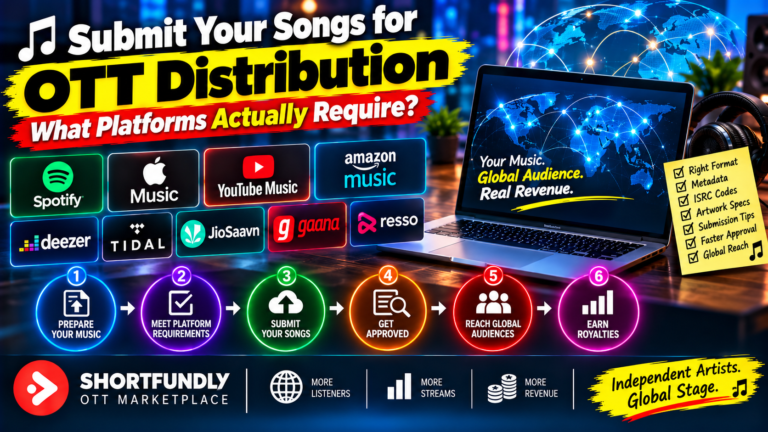
Also read: https://blog.shortfundly.com/ott/submit-songs-ott-distribution/
How Shortfundly Distribution Can Fit an Independent Creator’s Strategy
Independent creators looking for an organized distribution route can consider Shortfundly Distribution as part of their digital release planning.
Its broader distribution workflow can be useful for creators working with eligible music and audiovisual content who want to manage submission, review, asset delivery, and distribution through a structured process.
However, artists should always verify:
- Current content eligibility
- Current pricing
- Available partners
- Distribution territories
- Agreement terms
- Technical requirements
- Revenue and reporting conditions
These factors can change over time and may vary between projects.
Final Thoughts
Finding the best OTT distribution for independent songs is not simply about selecting the distributor with the biggest platform list.
A good distribution decision should consider your:
- Target audience
- Music genre
- Language
- Distribution territories
- Budget
- Rights ownership
- Revenue expectations
- Content format
- Release schedule
- Promotional strategy
Independent artists should prepare their audio, artwork, metadata, rights documentation, and promotional materials before beginning the submission process.
Shortfundly Distribution is one platform independent creators can consider when exploring structured distribution for eligible songs and video-song content.
The most important step is to review the current terms and requirements for your specific project before submitting.
When professional music production is combined with accurate metadata, clear rights, suitable distribution, and consistent promotion, independent artists can build a stronger foundation for long-term digital music growth.
Frequently Asked Questions
1. What is OTT distribution for independent songs?
OTT distribution is the process of delivering eligible music or music-related content to digital streaming and entertainment platforms through a distributor or aggregation service.
2. Can independent artists distribute songs without a record label?
Yes. Independent artists can explore digital distribution services that accept independent creators, subject to each service’s eligibility and submission requirements.
3. Is Shortfundly Distribution suitable for independent songs?
Shortfundly Distribution is one platform independent creators can consider for eligible songs and video-song content. Availability, pricing, requirements, and distribution partners should be confirmed for the specific project.
4. What do I need before distributing a song?
You generally need a final audio master, artwork, metadata, release information, and appropriate rights or licenses. Additional requirements depend on the distributor and content type.
5. How much does music distribution cost?
Costs vary by distributor and distribution model. Some services use upfront fees, subscriptions, revenue sharing, or project-based pricing.
6. Do I keep ownership of my song?
Ownership depends on the agreement you sign. Carefully review the rights and licensing clauses before submitting your music.
7. How long does song distribution take?
Processing time varies between distributors and platforms. Review, technical checks, corrections, delivery, and platform processing can all affect the timeline.
8. Can I distribute regional-language songs?
Yes, eligible regional-language music can be distributed through appropriate digital channels. Always verify that your selected distributor supports the relevant language and content type.
9. Should I release a single or album?
The choice depends on your audience, budget, content catalog, and promotional strategy. Singles can provide multiple promotional opportunities, while albums provide a larger body of work at once.
10. Does music distribution guarantee streams?
No. Distribution makes eligible content available through selected channels, but it does not guarantee audience reach, streams, playlist placement, or revenue.
11. What is the most important thing to check before choosing a distributor?
Review the distributor’s current platform reach, pricing, rights terms, revenue model, territories, content eligibility, reporting, and agreement duration before making a decision.
12. How can independent artists increase their chances of success?
Focus on music quality, rights management, accurate metadata, professional artwork, strategic distribution, consistent releases, and sustained promotion rather than relying on distribution alone.