Table of Contents
Learn what platforms require when you submit songs for OTT distribution, including audio files, metadata, rights, artwork, licensing, and release strategies.
The digital music industry has changed the way independent artists, musicians, producers, composers, and content creators release their work. Instead of depending entirely on traditional record labels, creators can now use songs OTT distribution services to deliver their music to digital platforms and reach audiences across different markets.
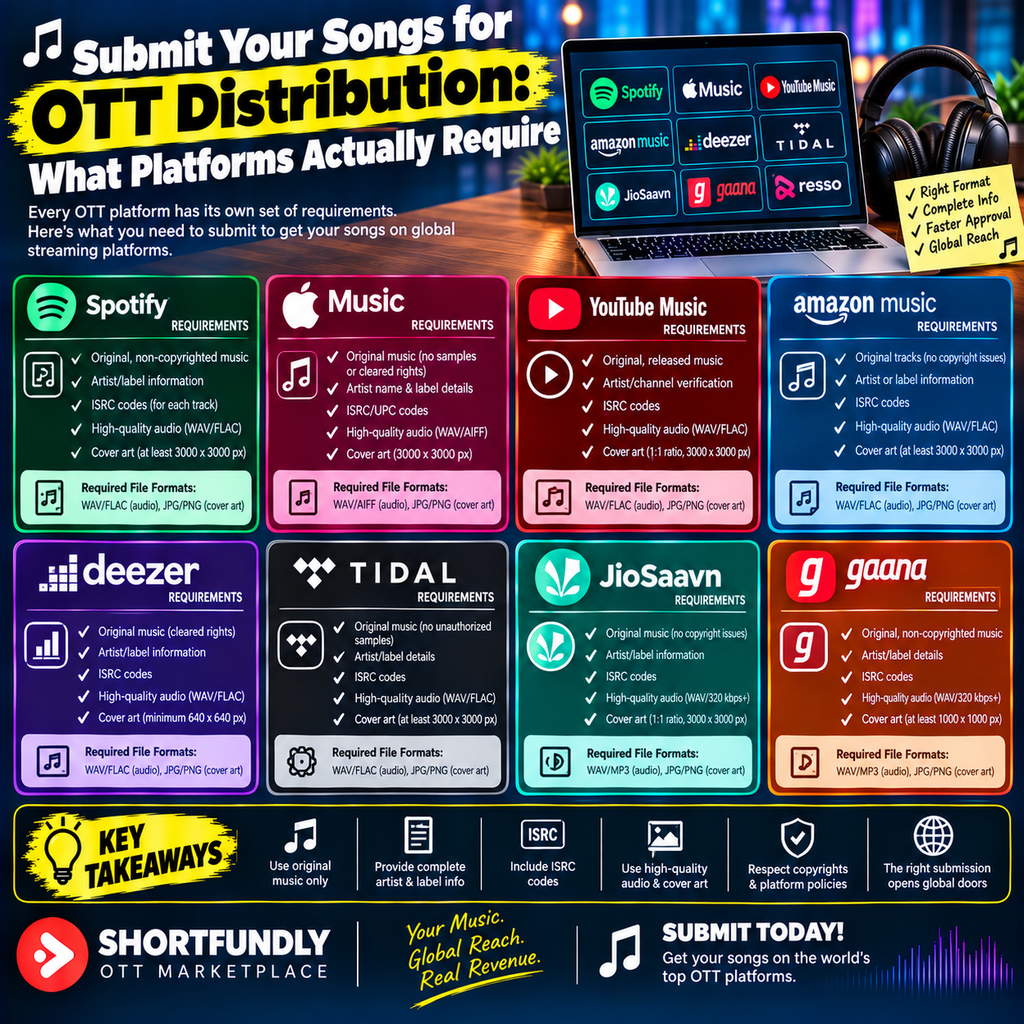
However, submitting a song for distribution is more than simply uploading an MP3 file. Digital platforms and distribution services typically require accurate audio files, metadata, cover artwork, ownership information, licensing documentation, and release details before a song can be considered for delivery.
Understanding these requirements before submission can help reduce avoidable delays and improve the overall quality of your release.
For independent creators looking for a structured distribution route, Shortfundly Distribution is one of the platforms worth considering for distributing eligible music and video-song content through its available distribution network.
What Is Songs OTT Distribution?
Songs OTT distribution refers to the process of delivering music and related audiovisual content to digital streaming and entertainment platforms through a distributor or aggregation service.
Instead of contacting every platform separately, a distribution service can provide a centralized submission and delivery process.
Depending on the distributor and the type of content, distribution may involve platforms and services operating across:
- Music streaming
- Video streaming
- OTT entertainment
- Digital content libraries
- Regional entertainment platforms
- International streaming services
The exact platforms available depend on the distributor, content type, licensing rights, territory, and current partner availability.
For creators, the main objective is to make a professionally prepared song available to the intended audience while maintaining control over ownership and release information.
Why Platforms Have Submission Requirements
Digital platforms receive a large volume of music and audiovisual content. As a result, they need standardized information and technical assets to process every release.
Submission requirements help platforms and distributors determine whether:
- The audio is technically suitable.
- The creator has the necessary rights.
- The metadata is accurate.
- The artwork meets technical standards.
- The release information is complete.
- The content complies with applicable policies.
- The requested distribution territories are properly defined.
A release with missing information can require additional review or corrections.
That is why preparing your song before submitting it is an important part of OTT music distribution.
1. High-Quality Audio File
One of the first things you should prepare is your final master audio.
The distributor may specify acceptable file formats, sample rates, bit depth, channel configuration, and other technical requirements. These requirements can vary between services.
Before uploading your song, make sure you are working with the final approved master, rather than a rough mix or unfinished version.
Your master should ideally be:
- Professionally mixed.
- Properly mastered.
- Free from unintended clipping.
- Free from background noise or technical artifacts.
- Exported according to the distributor’s current specifications.
- Checked from beginning to end before submission.
Do not repeatedly export the same audio file through multiple compressed formats if you can provide the original approved master in the distributor’s preferred format.
Why Audio Quality Matters
Streaming platforms deliver your music to listeners using different playback environments, including:
- Smartphones
- Headphones
- Bluetooth speakers
- Cars
- Home entertainment systems
- Computers
- Professional audio equipment
A technically poor master can become more noticeable after streaming compression.
Therefore, professional audio mastering should be treated as part of your distribution preparation rather than an optional final step.
2. Accurate Song Metadata
Metadata is one of the most important parts of a digital music submission.
Music metadata is the information that tells platforms what your release is and how it should be displayed.
Typical metadata can include:
- Song title
- Artist name
- Primary artist
- Featured artist
- Composer
- Lyricist
- Producer
- Album or EP title
- Genre
- Language
- Release date
- Copyright information
- Label information
- Territory information
- Version information
The exact fields depend on the distribution service and the type of release.
Why Metadata Accuracy Matters
Imagine that an artist’s name is written differently across multiple releases.
For example:
Arun Kumar
and
ArunKumar
A platform may treat them as different artist identities depending on its systems.
Consistent metadata helps create a cleaner digital presence and reduces unnecessary confusion.
Before submission, carefully check every field.
3. Song Title and Version Information
Your song title should be entered exactly as intended for public display.
If the release has a version designation, make sure it is accurately identified.
Examples can include:
- Original Version
- Radio Edit
- Acoustic Version
- Remix
- Instrumental
- Live Version
- Extended Version
Do not add unnecessary promotional words to the title.
For example, terms such as:
“Best New Song 2026 – Must Listen!!!”
are promotional rather than useful metadata.
A cleaner title generally makes the release easier to manage across digital services.
4. Artist and Contributor Information
Platforms and distributors may request detailed information about everyone involved in creating the recording.
Depending on the release, this can include:
- Main artist
- Featured artist
- Composer
- Lyricist
- Producer
- Remixer
- Publisher
- Label
- Other contributors
Providing accurate contributor information is particularly important when multiple people hold rights in a recording.
Do not assume that only the singer’s name matters.
A professionally prepared release should document the relevant creative and rights information before distribution.
5. Cover Artwork
Your song may also require cover artwork that meets the distributor’s technical specifications.
Artwork requirements can vary, but distributors commonly establish rules regarding:
- Image dimensions
- File format
- Resolution
- Text
- Logos
- Copyrighted images
- Offensive or misleading material
- Promotional claims
Your artwork should represent the release professionally.
Avoid using images that you do not have permission to use.
Common Artwork Mistakes
Some common problems include:
- Low-resolution images
- Blurry text
- Incorrect artist name
- Incorrect song title
- Watermarks
- Unauthorized photographs
- Platform-specific promotional badges
- Excessive advertising language
- Copyrighted images without permission
Create the final artwork only after confirming the distributor’s current specifications.
6. Proof of Rights and Ownership
One of the most important requirements for song OTT distribution is the ability to demonstrate that you have the necessary rights to distribute the content.
You should know exactly who owns:
- The master recording
- The composition
- The lyrics
- The artwork
- Any samples
- Any third-party material
If you are distributing someone else’s song, you may need appropriate licensing or authorization.
What About Samples?
Samples deserve particular attention.
If your song contains:
- A sampled recording
- A third-party vocal
- A copyrighted melody
- Licensed production material
- Stock audio with restrictions
you should verify that your license actually permits the intended commercial distribution.
Having purchased a sample does not automatically mean that every type of commercial use is permitted.
Read the applicable license terms.
7. Copyright and Licensing Information
Copyright information helps establish the ownership and licensing structure surrounding the release.
Depending on your project, you may need information relating to:
- © Composition rights
- ℗ Master recording rights
- Label ownership
- Publisher information
- Licensing arrangements
- Distribution territories
If multiple parties are involved, document the agreement before releasing the song.
A written agreement can help clarify who has authority to distribute the recording and how revenue should be handled.
8. Release Date and Distribution Schedule
Another important consideration is your planned release date.
Do not necessarily wait until the exact release day to upload your song.
Distribution services may need time for:
- Submission
- Content review
- Metadata validation
- Technical checks
- Corrections
- Delivery
- Platform processing
The exact timeline varies by distributor and platform.
For this reason, independent artists should create a music release schedule rather than treating distribution as a last-minute task.
A Practical Release Timeline
A simple planning structure could look like this:
| Stage | Suggested Activity |
|---|---|
| Several weeks before release | Finalize master |
| Several weeks before release | Prepare artwork |
| Before submission | Verify rights |
| Before submission | Prepare metadata |
| Submission period | Upload required assets |
| Review period | Respond to corrections |
| Release period | Begin promotion |
| After release | Monitor performance |
The actual processing time should always be confirmed with your selected distributor.
9. Language and Genre Information
Accurate classification can also be important for digital distribution.
Your submission may ask for information such as:
- Primary language
- Secondary language
- Genre
- Subgenre
- Explicit-content status
- Regional classification
For example, an Indian independent release could be categorized according to its actual language, such as:
- Tamil
- Telugu
- Hindi
- Malayalam
- Kannada
- Bengali
- Marathi
- Punjabi
Correct language information can help ensure that the release is represented accurately.
10. Lyrics and Additional Content
Some distribution services or platforms may request lyrics or additional release information.
If lyrics are submitted, make sure they match the final recording.
Common mistakes include:
- Missing lines
- Incorrect spelling
- Different words from the recording
- Incorrect language
- Missing repeated sections
For multilingual songs, carefully verify transliterations and translations where applicable.
If your release includes a video song, you may also need to prepare additional video assets and technical information.
11. Music Video Requirements Can Be Different
There is an important distinction between audio distribution and video-song distribution.
A music video may have additional requirements involving:
- Video resolution
- Aspect ratio
- Audio synchronization
- Encoding
- Subtitle information
- Thumbnail artwork
- Video metadata
- Copyright information
- Territory restrictions
Therefore, do not assume that the technical requirements for an audio-only release automatically apply to a video.
If you are distributing a video song through Shortfundly Distribution or another service, confirm the current video specifications before preparing the master file.
12. Explicit Content and Platform Policies
Your content may also need to be classified according to applicable platform policies.
If a song contains explicit language or mature themes, provide the correct classification when required.
Do not attempt to hide explicit material in order to bypass a platform’s requirements.
Accurate content labeling helps maintain compliance and reduces potential metadata corrections.
13. ISRC and Other Identifiers
Music releases can also involve identifiers such as ISRC codes.
The International Standard Recording Code identifies a particular sound recording or music video.
If you already have an ISRC associated with a recording, provide the correct identifier when the distributor requests it.
Avoid creating unnecessary duplicate identities for the same recording.
If you are releasing a completely new recording and do not already have the required identifier, check your distributor’s current process for assigning or handling it.
14. ISWC and Publishing Information
ISRC generally relates to the recording, while publishing and composition rights can involve other identifiers and registration systems.
This distinction matters because a song can involve several separate rights.
For example:
Composition: melody and lyrics
Master: the specific recorded performance
Publishing: rights associated with the underlying composition
If you are an independent artist who wrote, performed, and produced your own recording, you may control multiple rights.
If other creators participated, ownership can be divided among multiple parties.
Understanding these distinctions is essential before signing distribution agreements.
15. Territory and Licensing Rights
Not every release necessarily has identical rights in every country.
A song could have:
- Worldwide rights
- India-only rights
- Selected territory rights
- Exclusive rights
- Non-exclusive rights
- Time-limited rights
Before submitting your song, understand the rights you are actually authorized to distribute.
This becomes especially important when your music has already been licensed to a record label, film producer, music publisher, broadcaster, or another digital distributor.
Why Shortfundly Distribution Is Worth Considering
For independent creators searching for an organized route for OTT and digital content distribution, Shortfundly Distribution is one option worth considering.
Shortfundly Distribution supports eligible content submissions and provides a structured workflow that can help creators prepare and submit content for distribution through its currently available partners.
The platform’s distribution ecosystem can be relevant to creators working with different types of content, including eligible songs and video songs, along with other audiovisual formats.
The process is designed around steps such as:
- Checking applicable pricing.
- Registering or signing in.
- Adding content information.
- Reviewing requirements.
- Completing the applicable payment and agreement.
- Submitting the content.
- Going through content review.
- Uploading required release assets after approval.
- Distribution through currently available partners.
- Tracking content and earnings where applicable.
Creators should understand that submission does not automatically guarantee acceptance, platform placement, or streaming. Availability depends on eligibility, rights, content review, and the distribution partners available for the relevant project.
For the current submission process and applicable requirements, creators can check the Shortfundly Distribution platform directly.
How to Prepare Your Song Before Shortfundly Distribution Submission
Before submitting your content, prepare a complete digital release package.
Step 1: Finalize the Master
Make sure the final audio has been professionally mixed and mastered.
Step 2: Prepare Your Artwork
Create professional cover artwork that follows the current technical and content requirements.
Step 3: Organize Metadata
Create a master document containing:
- Song title
- Artist
- Composer
- Lyricist
- Producer
- Language
- Genre
- Release date
- Copyright information
- Label information
- Contributor information
Step 4: Verify Ownership
Confirm that you have the necessary rights to distribute every component of the release.
Step 5: Check Third-Party Material
Review all samples, beats, vocals, artwork, and other licensed materials.
Step 6: Prepare Identifiers
Have any existing ISRC or relevant identification information available.
Step 7: Check Current Requirements
Distribution requirements can change, so check the current submission instructions before uploading.
Step 8: Submit
Complete the required information and upload the appropriate assets.
Step 9: Respond to Review Requests
If corrections are requested, address them carefully rather than rushing the release.
Step 10: Plan Promotion
Once your release is approved and scheduled, begin your promotional campaign.
Audio Distribution vs Video Song Distribution
Creators should understand the difference between these two distribution strategies.
| Feature | Audio Distribution | Video Song Distribution |
|---|---|---|
| Main asset | Audio master | Video master |
| Cover artwork | Usually required | May include thumbnail/artwork requirements |
| Metadata | Required | Required |
| Video specifications | Not applicable | Required |
| Lyrics | May be requested | May be requested |
| Audio quality | Important | Important |
| Visual quality | Not applicable | Important |
| Rights verification | Essential | Essential |
| Promotional strategy | Audio-focused | Audio + visual |
Choosing the appropriate route depends on what you are actually releasing.
How Much Does Song OTT Distribution Cost?
There is no universal distribution fee for every song.
Pricing can depend on:
- Distributor
- Content type
- Duration
- Distribution package
- Number of destinations
- Territory
- Licensing model
- Additional services
- Taxes
Some services may charge an upfront fee, while others may operate through subscription, revenue-sharing, licensing, or a combination of commercial structures.
Before choosing a distributor, compare the total cost of distribution rather than focusing only on the initial submission fee.
If you are considering Shortfundly Distribution, check the current pricing calculation for your specific content because applicable pricing can vary by project.
How Do Artists Make Money From Song Distribution?
Distribution itself does not automatically generate a fixed amount of revenue.
Artist income can depend on:
- Number of streams
- Platform
- Territory
- Subscription model
- Advertising model
- Rights ownership
- Distributor agreement
- Label agreement
- Publishing arrangements
- Revenue-sharing terms
Therefore, creators should avoid assuming that every stream has the same monetary value.
A successful distribution strategy combines availability, rights management, audience development, promotion, and long-term catalog growth.
What Platforms Actually Look For
Although every platform has its own systems, professional digital distribution generally depends on a few core principles.
Technical Quality
The submitted content should meet the required technical specifications.
Rights Clearance
You should have the necessary authority to distribute the content.
Accurate Metadata
Every important field should be complete and consistent.
Professional Artwork
Your cover image should meet the applicable specifications.
Policy Compliance
Your release should comply with the distributor and platform’s content policies.
Correct Release Information
Dates, contributors, language, genre, and identifiers should be accurate.
These requirements are less about making a song “perfect” creatively and more about ensuring that the digital release is correctly documented and technically deliverable.
Common Reasons Music Submissions Need Corrections
Independent artists frequently make avoidable mistakes during digital distribution.
1. Incorrect Metadata
The artist name, title, contributor information, or copyright information may be inconsistent.
2. Poor Audio Export
The uploaded file may not meet the distributor’s technical specifications.
3. Unauthorized Artwork
The creator may use an image without the necessary rights.
4. Unclear Ownership
The creator may not have documented permission from collaborators or rights holders.
5. Incorrect Release Date
The release may be scheduled without allowing sufficient processing time.
6. Incorrect Version Information
A remix, live version, or acoustic version may be mislabeled.
7. Missing Rights Information
Important copyright or licensing details may be absent.
8. Unverified Samples
The song may contain third-party material without appropriate permission.
9. Last-Minute Submission
The creator may submit everything immediately before the planned release date.
10. Inconsistent Artist Identity
The artist name may be entered differently across multiple releases.
Avoiding these problems can make the submission process more organized.
Create a Professional Music Distribution Checklist
Before pressing the submit button, review this checklist.
Audio
- Final master completed
- Audio quality checked
- Correct file format
- No unintended clipping
- Beginning and ending checked
Metadata
- Song title confirmed
- Artist name confirmed
- Featured artists listed
- Composer listed
- Lyricist listed
- Producer listed
- Genre selected
- Language selected
- Release date confirmed
Rights
- Master ownership verified
- Composition rights verified
- Samples checked
- Collaborator permissions documented
- Artwork rights verified
- Distribution rights confirmed
Artwork
- Correct artist name
- Correct title
- Required dimensions
- Appropriate resolution
- No unauthorized images
- No unnecessary promotional claims
Release Planning
- Distribution submitted in advance
- Promotional assets prepared
- Social media campaign planned
- Release announcement prepared
- Post-release promotion scheduled
How to Promote a Song After OTT Distribution
Distribution is only one part of the music release strategy.
Once your song becomes available, you need to create reasons for people to discover it.
Consider combining:
Social Media
Create short-form videos featuring:
- Chorus clips
- Behind-the-scenes footage
- Studio sessions
- Lyric snippets
- Artist stories
- Performance clips
YouTube Content
Create supporting content such as:
- Lyric videos
- Music videos
- Acoustic performances
- Making-of videos
- Artist interviews
Influencer Promotion
Work with relevant creators who already reach your target audience.
Regional Promotion
If your song is in an Indian regional language, focus on communities and creators who understand that language and culture.
Pre-Release Campaigns
Start building awareness before the song becomes available.
Post-Release Content
Continue promoting the song after launch instead of treating the release date as the end of the campaign.
Why Regional Music Has Significant Digital Potential
India has one of the world’s most diverse music environments.
Audiences consume music in numerous languages and cultural styles.
This creates opportunities for independent artists working in:
- Tamil
- Telugu
- Hindi
- Malayalam
- Kannada
- Bengali
- Marathi
- Punjabi
- Gujarati
- Odia
- Other regional languages
A well-prepared regional release can combine local cultural relevance with digital distribution.
This makes regional song OTT distribution an important consideration for independent creators.
Should You Distribute a Single, EP, or Album?
The right release format depends on your artistic and marketing strategy.
Single
A single can be useful for:
- Testing audience response
- Building an artist profile
- Maintaining regular releases
- Supporting a specific promotional campaign
EP
An EP provides multiple songs while remaining smaller than a full album.
Album
An album can provide a larger catalog but generally requires more planning and promotion.
For emerging independent artists, releasing music consistently can sometimes be easier to manage than preparing a large catalog for a single launch.
The appropriate strategy depends on the artist, audience, budget, and content.
How to Choose a Songs OTT Distribution Partner
Before selecting a distributor, compare several factors.
Platform Reach
Check which destinations are currently available.
Pricing
Understand upfront fees, recurring fees, revenue sharing, and additional charges.
Rights
Read the agreement carefully to understand what rights you are granting.
Territory
Check where your content can be distributed.
Support
Understand how the distributor handles technical and metadata issues.
Reporting
Check what information you can access about your content and earnings.
Content Eligibility
Confirm that the distributor accepts your specific type of music or video content.
A distribution company should be evaluated according to your project’s actual requirements rather than based solely on marketing claims.
Also read: https://blog.shortfundly.com/ott/release-songs-ott-platforms/
Final Thoughts
Submitting your songs for OTT distribution requires more preparation than simply uploading an audio file.
Your release should be supported by a high-quality master, accurate metadata, professional artwork, clear rights documentation, appropriate identifiers, and a realistic release schedule.
The most important principle is simple: prepare the digital release before you submit it.
Independent artists can explore different distribution routes depending on their goals, content type, territories, and commercial requirements. Shortfundly Distribution is one of the platforms worth considering for eligible songs and video-song content, particularly for creators looking for a structured submission and distribution workflow.
Before submitting any release, always review the distributor’s current requirements, pricing, agreement terms, content eligibility, and available distribution partners.
A professionally prepared song has a better foundation for moving through the digital distribution process smoothly and reaching audiences across the platforms available to it.