Table of Contents
1. Understanding Pilot Film OTT Distribution Pricing
A pilot film is often created to demonstrate the potential of a larger television series, web series, or digital production.
Consequently, its commercial value can extend beyond the pilot itself.
A successful pilot can attract viewers, demonstrate production quality, introduce characters, and support future financing discussions. OTT distribution can provide another route for audiences to discover the project.
However, distribution has costs.
These costs can appear as fixed fees, revenue shares, delivery expenses, marketing charges, or combinations of these structures.
What Does OTT Distribution Usually Cover?
Depending on the agreement, distribution services can include:
- Content delivery
- Technical quality control
- Metadata preparation
- Artwork preparation
- Subtitle coordination
- Closed-caption preparation
- Platform pitching
- Rights administration
- Licensing administration
- Revenue collection
- Royalty reporting
- Territory management
Not every distributor provides every service.
Therefore, we should always compare the actual deliverables rather than simply comparing advertised prices.
Why the Cheapest Proposal Isn’t Always the Best
Suppose Distributor A charges a low upfront fee but offers limited services.
Distributor B charges more but handles technical delivery, localization, platform pitching, reporting, and rights administration.
The second proposal may ultimately provide greater value.
Conversely, paying for unnecessary services can reduce a producer’s return.
The goal is therefore commercial efficiency, not simply the lowest price.
Also read: https://blog.shortfundly.com/ott/pilot-film-ott-distribution-2/
2. One-Time OTT Distribution Fees Explained
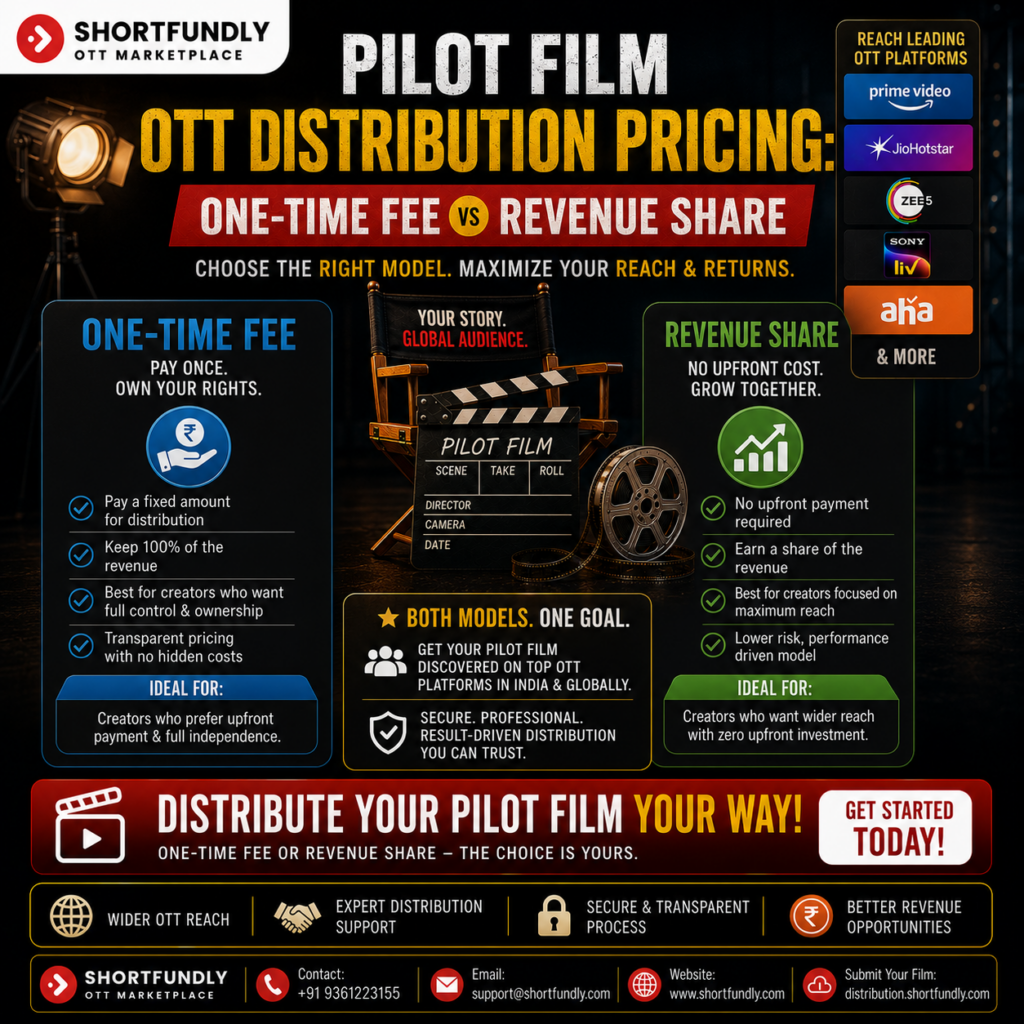
A one-time distribution fee is a fixed amount paid for agreed distribution services.
The amount can vary substantially depending on the project and service package.
The contract should specify exactly what the fee covers.
For example, the fee might cover initial content preparation and distribution support but exclude dubbing, subtitles, additional territories, or marketing campaigns.
Advantages of a Fixed Distribution Fee
A fixed fee offers several potential benefits.
First, budgeting becomes easier.
The producer knows the initial distribution expense.
Second, future revenue may remain largely with the producer.
This depends on the agreement.
Third, accounting can be simpler.
There may be fewer ongoing revenue calculations.
Finally, a fixed fee can work well for producers who expect strong future performance.
If a project earns significant revenue, retaining a larger percentage may become valuable.
Potential Disadvantages
The producer assumes more upfront risk.
If the film performs poorly, the distribution fee may not be recovered.
Additionally, a fixed fee does not necessarily guarantee placement or audience performance.
Therefore, producers should determine whether the agreement promises distribution services or actual platform acceptance.
Those are not the same thing.
3. Revenue-Share OTT Distribution Explained
Under a revenue-share arrangement, the distributor receives a percentage of qualifying revenue.
This model can reduce upfront financial pressure.
However, it can become expensive if the project performs exceptionally well.
For example, imagine a hypothetical agreement involving a 20% distributor share.
| Qualifying Revenue | Distributor Share | Producer Share |
|---|---|---|
| $5,000 | $1,000 | $4,000 |
| $10,000 | $2,000 | $8,000 |
| $25,000 | $5,000 | $20,000 |
| $50,000 | $10,000 | $40,000 |
| $100,000 | $20,000 | $80,000 |
These figures are illustrative.
Actual contracts may include deductions before the percentage is applied.
That distinction can completely change the economics.
Why Producers Like Revenue Sharing
Revenue sharing can be attractive because the initial financial barrier may be lower.
The distributor also has an ongoing commercial interest in the project’s performance.
However, producers should carefully review the definition of revenue.
A percentage of gross receipts can produce a different result from a percentage of net receipts.
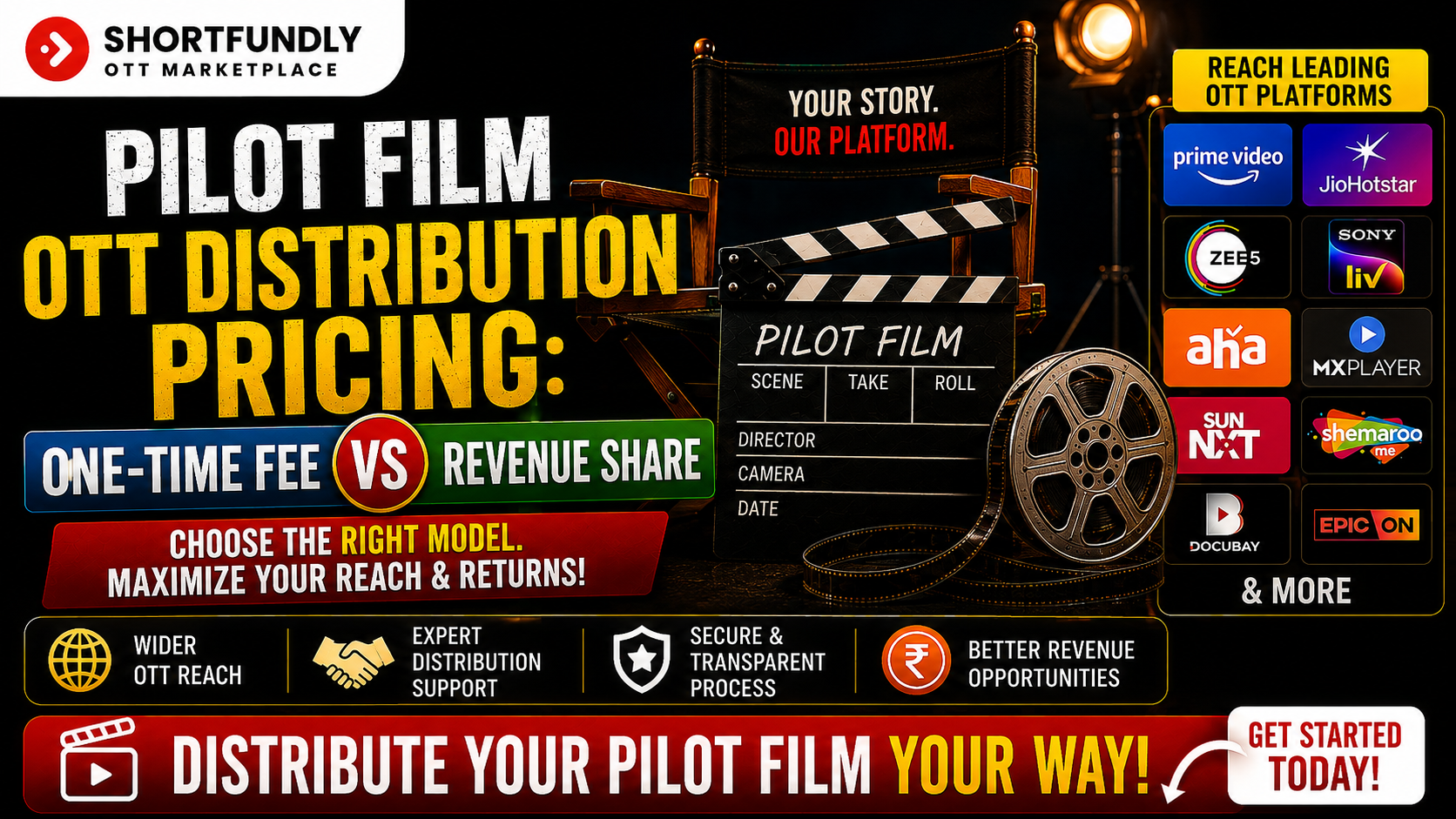
4. One-Time Fee vs Revenue Share: Detailed Comparison
The right model depends on the producer’s financial position and expectations.
| Consideration | One-Time Fee | Revenue Share |
|---|---|---|
| Initial expense | Higher | Lower or potentially lower |
| Predictability | High | Moderate |
| Producer’s future percentage | Potentially higher | Lower |
| Upfront risk | Higher | Lower |
| Long-term distributor participation | Usually limited | Usually ongoing |
| Suitable for high-performing projects | Often attractive | Can become expensive |
| Suitable for limited budgets | Potentially difficult | Often more accessible |
| Accounting | Usually simpler | Requires ongoing reporting |
Neither structure is automatically superior.
Instead, we should calculate the expected total cost.
5. Calculate the OTT Distribution Break-Even Point
A simple break-even calculation can make negotiations much clearer.
Suppose a fixed distribution fee costs $3,000.
A revenue-share proposal instead takes 15% of qualifying revenue.
The theoretical break-even point is:
$3,000 ÷ 15% = $20,000
At approximately $20,000 in qualifying revenue, both structures would produce the same distributor compensation.
Above that level, the revenue-share arrangement could cost more.
Below that level, the revenue-share arrangement could cost less.
However, this calculation only works if both proposals calculate revenue using identical definitions.
That is rarely something we should assume.
6. Gross Revenue vs Net Revenue: The Most Important Pricing Detail
Revenue terminology deserves special attention.
A contract may refer to:
- Gross revenue
- Gross receipts
- Net revenue
- Net receipts
- Adjusted gross revenue
- Producer net receipts
These terms aren’t interchangeable.
Example
Suppose an OTT platform generates $10,000 from a title.
Assume $2,000 is deducted for platform-related charges.
The remaining amount becomes $8,000.
If the distributor receives 20% of gross revenue, its share could be $2,000.
If the distributor receives 20% of the $8,000 net amount, its share could be $1,600.
That difference is significant.
Therefore, producers should ask for a written revenue waterfall.
The waterfall should show:
Platform revenue → permitted deductions → distributor share → producer share.
This simple diagram can remove considerable uncertainty.
7. Review Every Distribution Right Before Signing
Price should never be separated from rights.
A distributor may request rights covering:
- Digital distribution
- OTT
- Television
- Mobile
- Internet
- Download
- Streaming
- Advertising-supported platforms
- Subscription platforms
- Transactional platforms
We should only grant rights that are necessary for the agreed distribution strategy.
Unnecessary rights can restrict future opportunities.
8. Territory Rights Can Affect the Value of a Deal
OTT agreements can be limited to specific countries or territories.
Alternatively, a distributor may request worldwide rights.
A global agreement can simplify administration.
However, it can also prevent the producer from pursuing separate opportunities in markets where the project might perform particularly well.
We should therefore ask:
Which countries are covered?
Are territories exclusive?
Can rights be separated by region?
Can additional territories be added later?
These questions become especially important for films with multilingual or international potential.
9. Exclusive vs Non-Exclusive OTT Distribution
Exclusivity can substantially affect distribution pricing.
An exclusive agreement may prevent the producer from working with another distributor for the same rights during the contract term.
A non-exclusive arrangement provides greater flexibility.
Before Accepting Exclusivity, Check:
- Contract duration
- Territory
- Platform category
- Media rights
- Language rights
- Renewal terms
- Minimum performance requirements
- Termination rights
- Rights reversion
A short exclusive agreement and a long global exclusive agreement should never be treated as economically identical.
10. Hidden OTT Distribution Costs Producers Should Check
The advertised distribution fee may not represent the complete expense.
Additional costs may include:
- Subtitle creation
- Dubbing
- Trailer creation
- Poster design
- Artwork revisions
- Metadata revisions
- Technical re-delivery
- Closed captions
- Localization
- Marketing
- Platform-specific formatting
- Legal documentation
- Additional territory delivery
A producer should request a complete fee schedule before signing.
Use This Simple Question
Ask:
“Are there any additional charges beyond the stated distribution fee or revenue share?”
Then request the answer in writing.
That small step can prevent unpleasant surprises later.
11. Distribution Does Not Automatically Mean Marketing
This distinction is often misunderstood.
Distribution and marketing are different functions.
Distribution concerns getting content into the commercial delivery and licensing pipeline.
Marketing focuses on generating awareness and audience interest.
A distributor may distribute a film without guaranteeing:
- Homepage placement
- Featured placement
- Paid advertising
- Social campaigns
- Influencer campaigns
- Editorial promotion
- Trailer promotion
Therefore, any promotional commitment should appear clearly in the agreement.
12. Royalty Reporting and Payment Terms
Revenue sharing only works effectively when reporting is transparent.
A producer should understand:
- Reporting frequency
- Payment dates
- Currency
- Minimum payment thresholds
- Accounting periods
- Permitted deductions
- Audit rights
- Statement format
- Tax treatment
The agreement should also explain how foreign-currency revenues are converted.
A producer shouldn’t have to guess how the final royalty figure was calculated.
13. Minimum Guarantees and Advances
Some licensing agreements can include minimum guarantees or advances.
These arrangements can provide greater financial certainty.
However, the producer should determine whether the payment is:
- Recoupable
- Non-recoupable
- Deducted from future royalties
- Territory-specific
- Conditional on delivery
- Connected to exclusivity
A large advance isn’t automatically the best deal.
The complete contract economics matter more.
14. Contract Duration and Renewal Terms
Distribution contracts should clearly state their duration.
A short agreement may provide flexibility.
A longer agreement can provide continuity.
However, long contracts can also lock away rights.
We should examine:
Initial term + renewal term + notice period + termination rights.
Automatic renewal clauses deserve particular attention.
If renewal happens automatically unless notice is given within a narrow window, producers should record the relevant deadline.
15. Termination and Rights Reversion
A strong distribution contract should explain what happens after termination.
Relevant provisions may address:
- Content takedown
- Platform removal
- Remaining royalties
- Outstanding payments
- Reporting obligations
- Rights reversion
- Promotional materials
- Metadata
- Physical or digital assets
The agreement should clearly state when rights return to the producer.
Without a clear rights-reversion mechanism, future distribution can become unnecessarily complicated.
16. How Shortfundly Distribution Can Fit Into Your OTT Strategy
Shortfundly Distribution can be considered when independent creators evaluate structured OTT distribution options.
Producers should compare the specific services offered against their project’s needs.
Important considerations include:
- Distribution scope
- Platform strategy
- Pricing structure
- Rights
- Territories
- Technical delivery
- Revenue terms
- Reporting
- Contract duration
- Marketing support
Creators can review the official Shortfundly Distribution website for current information and service details.
The commercial terms should always be reviewed based on the specific proposal received.
17. How to Negotiate a Better OTT Distribution Agreement
Negotiation doesn’t always mean demanding a lower price.
We can negotiate the overall value of the agreement.
For example, a producer might request:
- Lower upfront fees
- Reduced revenue percentage
- Shorter exclusivity
- More territories
- Better reporting
- Stronger marketing commitments
- Faster payment cycles
- Clearer termination provisions
- Lower renewal costs
A distributor may be more willing to adjust one commercial term than another.
Therefore, producers should identify their priorities before negotiations begin.
18. Seven Questions to Ask Before Signing
1. What exactly am I paying for?
Request a detailed list of deliverables.
2. What percentage does the distributor receive?
Confirm whether the percentage applies to gross or net revenue.
3. Which expenses can be deducted?
Request a complete deduction schedule.
4. Which rights am I granting?
Check territories, platforms, languages, and media.
5. Is the agreement exclusive?
If yes, determine precisely what is exclusive.
6. How often will I receive reports and payments?
The contract should provide clear deadlines.
7. What happens when the agreement ends?
Confirm takedown procedures and rights reversion.
19. Practical Pilot Film OTT Distribution Checklist
Before submitting a pilot film for distribution, we can use this checklist:
- Final master completed
- Audio specifications confirmed
- Subtitle files prepared
- Closed captions prepared where required
- Poster artwork completed
- Trailer completed
- Synopsis prepared
- Metadata prepared
- Cast and crew information verified
- Music rights confirmed
- Actor agreements documented
- Location permissions documented
- Third-party material cleared
- Copyright ownership verified
- Distribution rights confirmed
- Territory rights reviewed
- Exclusivity reviewed
- Fee structure reviewed
- Revenue percentage confirmed
- Deduction schedule reviewed
- Reporting terms confirmed
- Payment terms confirmed
- Contract duration reviewed
- Termination terms reviewed
- Rights reversion confirmed
20. Frequently Asked Questions About Pilot Film OTT Distribution Pricing
Is a one-time OTT distribution fee better than revenue sharing?
Not necessarily.
A fixed fee can be attractive when a producer expects strong future revenue.
Revenue sharing can reduce upfront financial pressure.
The right choice depends on the project’s expected earnings and contract terms.
How much does OTT film distribution cost?
There is no universal price.
Costs vary according to distribution services, territories, rights, technical requirements, marketing, and commercial arrangements.
Producers should compare complete proposals instead of relying on generic industry prices.
Does paying a distribution fee guarantee OTT placement?
Not automatically.
A distribution service may provide pitching and delivery without guaranteeing acceptance.
Any guarantee should be explicitly stated in the written agreement.
What percentage do OTT distributors take?
There is no universal percentage.
The percentage depends on the distributor, content, territory, platform, rights, and negotiation.
More importantly, producers should understand the revenue base used to calculate the percentage.
What is the difference between gross and net revenue?
Gross revenue generally refers to revenue before specified deductions.
Net revenue generally refers to the amount remaining after agreed deductions.
The exact definitions must come from the contract.
Should an independent filmmaker accept an exclusive distribution deal?
Exclusivity can be useful when the distributor provides meaningful platform access.
However, producers should carefully evaluate the duration, territories, rights, and termination provisions.
Can producers negotiate OTT distribution fees?
Yes, commercial terms can often be negotiated.
Producers can discuss fees, revenue percentages, contract duration, territories, marketing, reporting, and exclusivity.
What should a producer check before signing an OTT contract?
The producer should check ownership, rights, territories, exclusivity, fees, revenue definitions, deductions, reporting, payments, contract duration, termination, and rights reversion.
Is revenue sharing risky for a successful pilot?
It can be.
If revenue becomes substantial, a percentage-based arrangement may result in significant distributor payments over time.
However, it can also reduce upfront financial risk.
The best choice depends on the complete economics.
21. Final Decision: One-Time Fee or Revenue Share?
The best pilot film OTT distribution pricing model depends on the project’s financial position, expected performance, rights strategy, and distribution requirements.
A one-time fee may suit producers who have sufficient capital and expect meaningful future revenue. It provides greater upfront cost certainty and may allow the producer to retain more future revenue.
A revenue-share agreement may suit producers who want to reduce initial expenditure. It can align the distributor’s compensation with the project’s commercial performance.
However, the headline percentage doesn’t tell the whole story.
Before signing any agreement, we should examine:
The fee.
The revenue definition.
The permitted deductions.
The territories.
The rights.
The exclusivity.
The contract term.
The marketing obligations.
The reporting system.
The payment schedule.
The termination provisions.
The rights-reversion mechanism.
For independent filmmakers exploring services such as Shortfundly Distribution, the strongest approach is to compare the complete distribution package against the project’s goals and budget.
Ultimately, the right OTT distribution deal isn’t necessarily the cheapest proposal. It’s the agreement that provides the best balance between upfront risk, long-term revenue, rights protection, platform access, and professional distribution support.